
What the day contains
Social and emotional learning
The hardest curriculum in the building, the one that predicts school best, and the one where we most actively refuse the standard tools.
Sharing, waiting, losing, apologising and calming down are genuinely difficult, they are learned by doing them badly a great many times, and they matter more for how school goes than anything academic a four-year-old can be taught.
They are also where most early-years settings reach for tools that work in the short term by producing compliance and cost something in the long term. We do not use those, and this page says which ones and why.

What we do not use, and why
No behaviour chart, no traffic-light system, no cloud-and-sunshine board, and no moving a child's name down a list in front of the room. A three-year-old whose name sits under a sad face all morning has not learned about behaviour, they have learned something about themselves, and it is the children who most need help who spend the most time at the bottom.
No naughty step and no time-out in isolation. A dysregulated three-year-old sent away alone is a child asked to do the hardest thing they cannot yet do without the person who could help.
And no public praise as a control mechanism — I like the way Amina is sitting nicely — which works by making every other child briefly the wrong one. It is effective and it is corrosive.
What we do instead
Stay with the child. An adult sits alongside, says what happened and names what everybody felt, and waits. Co-regulation is not a technique, it is an adult lending a nervous system, and it is the whole of the job at this age.
There is a calm corner in each room — a cushion, a canopy, a basket of soft things — and it is a place a child chooses, never a place a child is sent. The moment it becomes a punishment it stops working, permanently, and children can tell the difference immediately.
Change the situation before correcting the child. Most conflict at two and three is a design problem — one of a thing, two children, no words — and altering the setup is both kinder and more effective than teaching a lesson to somebody who cannot yet hold it.
Repair, which is the part that matters
After a conflict, both children stay involved. Not a forced apology, which teaches a child that saying a word ends an obligation, but something concrete: fetching the cloth, helping rebuild the tower, checking whether the other child is alright.
A forced sorry is the single most common thing adults ask for and the least useful thing children learn. What we want is a four-year-old who notices they have upset somebody and does something about it, and that is built by practising the doing.
Both families hear about anything significant on the day, in the same words, without either child being named to the other. That is the same rule as for biting and for the same reason.
Why this is on the page about photographs
Because a child's social life is precisely the thing a daily photo stream cannot show you. Nobody photographs the fortnight your child has been shadowing one other child who does not want to play, or the twenty minutes after a nap when they could not be comforted.
Those are the things that would actually change what you do this evening. So they go in the written note and into a conversation at the door, in the week they are happening, rather than into a termly review where they arrive too late to be useful.
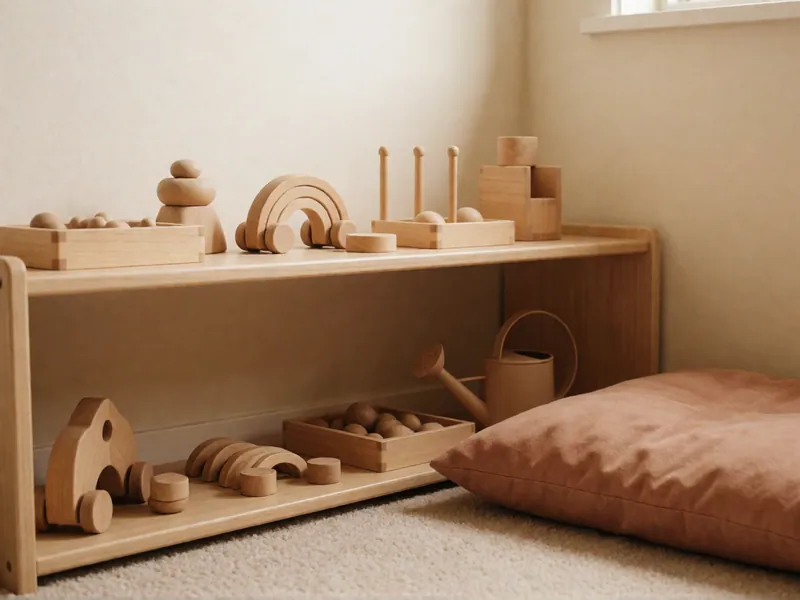
There are no children in any photograph on this site. There is not a single child in any photograph on this website. Every image here shows our rooms, our materials, our food or our educators, and that is a decision rather than a gap in the budget. Marketing photographs of children are somebody else's children, used to sell a place to you; and a daily app photograph of a smiling child tells you about one second of a nine-hour day and nothing about the other thirty-two thousand. What we send home instead is a written note about sleep, food, mood and what actually happened, from the person who was in the room.
Included as standard
What is included
No behaviour chart or traffic lights
The children who most need help spend the most time at the bottom of one.
No naughty step and no isolated time-out
A dysregulated three-year-old sent away alone has been asked to do the hardest thing without the person who could help.
A calm corner a child chooses
Never a place a child is sent. The moment it becomes a punishment it stops working, permanently.
An adult who stays alongside
Co-regulation is an adult lending a nervous system, and it is most of the job at this age.
The situation changed before the child is corrected
Most conflict at two and three is a design problem rather than a behaviour problem.
Repair rather than a forced apology
Fetching the cloth, rebuilding the tower, checking the other child. Practising the doing.
Same-day reporting to both families
In the same words, without either child being named to the other.
Social difficulty raised in the week
Not saved for a termly review, by which point it is too late to be useful.
When to make an appointment
Signs this is worth an assessment
- You do not want your child's name on a chart in front of a room.
- You want an adult to stay with your child rather than send them away.
- You are sceptical of forced apologies.
- You want to hear about a difficult fortnight while it is happening.
- Your child is having trouble with one particular friendship.
- You want the calm corner to be somewhere your child chooses rather than somewhere they are put.
Social & emotional — what it costs
- No behaviour chart, no traffic lights and no public naming of children who are struggling. What we do instead, and why, is written out on the page.Included
Every rate on this site is published in full on the tuition page, including the ones that make us look expensive. Meals, snacks, nappy changing, settling-in sessions and the whole curriculum are inside the weekly fee — there is no premium tier and no outside provider invoicing you separately for a music class. The two charges that are not in the weekly fee are registration, at $75 a year per family rather than per child, and late collection after 6:15pm at $1 a minute, which goes to the two members of staff who stayed. If your child is three or four, read the 3-K page before you read this one.
Questions we are actually asked
Social & emotional — frequently asked
Do you use time-out?
No, and not a naughty step either. A dysregulated three-year-old sent away alone has been asked to do the hardest thing they cannot yet do without the person who could help them do it. An adult stays with them instead.
Is the calm corner a punishment?
No, and it stops working the moment it becomes one. It is somewhere a child goes because they want to, and children detect the difference immediately and permanently. Nobody is ever sent there.
Why no reward chart?
Because the children who most need help are the ones who spend the most time at the bottom of it, and what they learn is not about behaviour. It works in the short term by producing compliance and costs something later.
Do you make children say sorry?
No. A forced apology teaches that saying a word ends an obligation. What we ask for is something concrete — fetching the cloth, helping rebuild, checking the other child is alright — because noticing you have upset somebody and doing something about it is built by practising the doing.
How will I know if my child is struggling socially?
You will hear it in the week it is happening, in the written note and in a conversation at the door. A child's social life is exactly what a photo stream cannot show, and a termly review arrives too late to be useful.
Related programmes
Families who read this also read
Twos room
The year with the most change in it and the most patience required. Language, toilets, friendships and a great many strong opinions.
$395 / week
Play-based learning
The approach with the best evidence behind it for children under five, and the one that photographs worst. We chose it anyway.
Included
Kindergarten readiness
Managing a coat, a lunch, a toilet, a queue and six hours away from home. Reading is not on this list and does not need to be.
Included
Observation & referral
We watch, we write it down, and where something concerns us we tell you early and point you at Early Intervention. We do not diagnose.
IncludedTuesday and Thursday mornings, while the children are here
Come and see the room
A tour here happens during a session, in the room your child would actually be in, at the time of day they would be in it. You meet the person who leads that room rather than only the director, and you see the noise and the mess that are genuinely there. It takes an hour. If your child is three or four we will ask whether you have applied for free 3-K or Pre-K for All before we quote you a rate, because a good many families should not be paying us at all.