Care by age
Pre-kindergarten, four to five years
Pre-K for All is free and universal in New York City. If you are about to pay us full-time for a four-year-old, we would like you to be certain you had to.
The caveat on the preschool page applies here with more force. Pre-K for All has been universal in this city for a decade, it is free, it is full-day, and it is not means-tested. A family paying $345 a week for a four-year-old's daytime hours without having applied is very likely spending money they did not need to.
Where families do pay us it is almost always about hours — the half-hour at each end that makes a commute possible — or about not having received an offer they can reach. Diego runs this room and also runs the after-school hours, which means he sees these children come back at half past three the following year still in the uniform. That view shapes what he thinks the year is for.
What the year before school is actually for
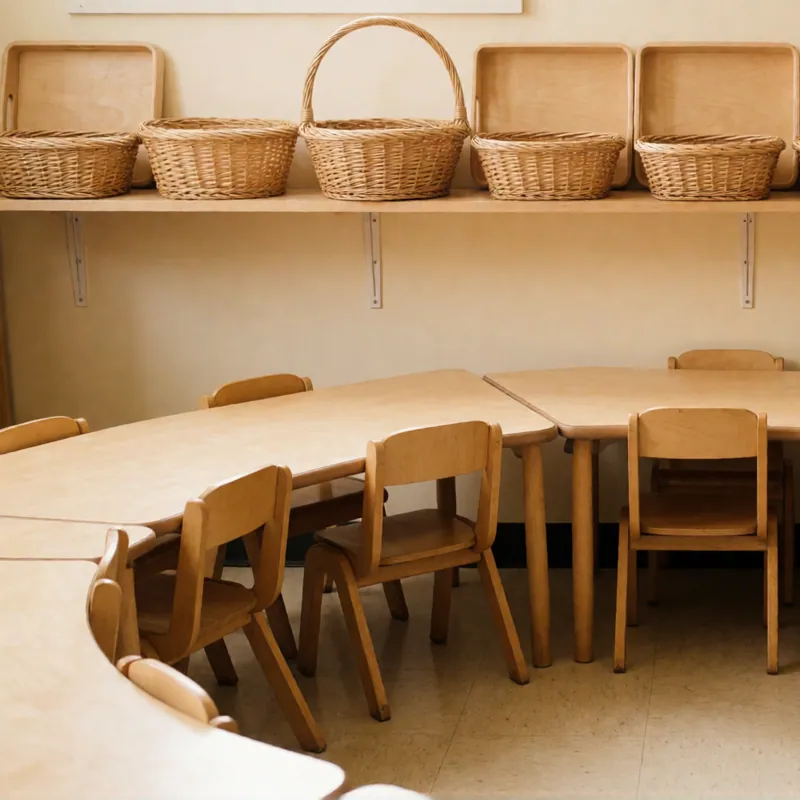
Managing a coat, a lunch, a bag and a toilet without an adult. Waiting. Queueing. Sitting in a group for a while and getting up again without a scene. And asking an adult for help, which is harder than it sounds and is the single most useful thing a child can arrive able to do.
Stamina, which is badly underrated. Six hours away from home is a long day for a five-year-old, and a child who is exhausted by eleven cannot access anything else on the list however well they know their letters.
Separating at a door and recovering quickly. Handling not getting what they wanted. Repairing things with another child after a fight. Diego is unambiguous that this list, and not the alphabet, is what makes September go well or badly.
Why there is still no worksheet
Because drilling letters at four produces children who can perform letters at four, at the cost of the play that was doing the other work — and because a room run that way sorts children early into the ones who find it easy and the ones who have learned they do not.
Children who are reaching for print get everything we have, enthusiastically. The distinction is who is initiating. A child pulling towards letters is followed; a curriculum pushing letters at twelve four-year-olds regardless of where any of them are is what we decline.
This is the request we receive most often and the one we turn down most consistently, and there is a page that makes the full argument rather than leaving it as a policy line.
The transition itself
A written summary goes home each spring for every child leaving for kindergarten. It says what we actually observed — what they can do, what they find hard, what helps — rather than scoring your child against a scale we made up.
We will talk to you about which school, honestly, including when the honest answer is that we do not know your local school and you should ask parents who do. We have no relationships to protect and no reason to steer you.
And many of these children come back to us in September for the before-and-after-school hours, which means the transition is not a goodbye. It also means Diego finds out how it went, which is the feedback loop most nurseries do not have.
If your child is three or four, the City may do this for nothing. New York City gives every resident three- and four-year-old a free, full-day place in 3-K or Pre-K for All, regardless of family income or immigration status. For the 2026-2027 year that meant children born in 2023 for 3-K and 2022 for pre-K, with applications open from 14 January to 27 February 2026. We are raising this before we quote you a weekly rate, on the pages where you are most likely to be about to pay us, because a family paying for a four-year-old's daytime hours without having applied is usually spending money the City would have covered. Families still pay us for these ages for good reasons — hours beyond what a free place covers, or not getting one — and neither of those is a reason to leave the question unasked.
Included as standard
What is included
The 3-K and pre-K conversation, first
We ask whether you have applied before we quote a rate, and we help with the paperwork whatever it costs us.
A room built for independence
Coats, bags, lunches and the washroom all reachable and managed by the child rather than by an adult.
Long play periods, protected
Still the core of the day at four. Stamina, planning and persistence are built in long stretches or not at all.
Read aloud twice a day
Small groups, real books, and children handling them. Plus singing, rhyme and playing with the sounds in words.
A written spring summary
What we observed, in plain language, for you and for the school. Not a score.
Before and after school hours the following year
Most of these children come back in September, which is how we find out how the transition actually went.
A cooked lunch and two snacks
Included, as in every room. No packed lunch and no meal supplement.
No drills, no tutoring, no premium track
One curriculum, and a published argument for why we will not change it on request.
When to make an appointment
Signs this is worth an assessment
- You have a Pre-K for All place but it does not cover the hours you work.
- You applied and did not receive an offer within reach.
- You want the year spent on independence and stamina rather than on letters.
- You would like a written summary for the school that describes your child rather than ranks them.
- You will need before-and-after-school cover next year and want continuity.
- You want somebody to tell you plainly that your four-year-old is doing fine, with the observations to back it.
Pre-kindergarten — what it costs
- Full-time, five days. The same caveat as preschool applies with more force: Pre-K for All is free and universal in this city, and a family paying us full-time for a four-year-old should be certain they had to.$345 / week
Every rate on this site is published in full on the tuition page, including the ones that make us look expensive. Meals, snacks, nappy changing, settling-in sessions and the whole curriculum are inside the weekly fee — there is no premium tier and no outside provider invoicing you separately for a music class. The two charges that are not in the weekly fee are registration, at $75 a year per family rather than per child, and late collection after 6:15pm at $1 a minute, which goes to the two members of staff who stayed. If your child is three or four, read the 3-K page before you read this one.
Questions we are actually asked
Pre-kindergarten — frequently asked
Is pre-K free in New York City?
Yes. Pre-K for All is free, full-day and universal for eligible four-year-olds who live in the city, with no means test and no regard to immigration status. For the 2026-2027 year, children born in 2022 applied. If you have not applied, that is the first thing to do.
Then why would I pay you?
Hours, mostly. A free place covers the school day and not the half-hour at each end that makes a commute work. The other common reason is not receiving an offer you can actually travel to. Both are real; neither is a reason for us to have opened with the fee.
Will my child be ready for kindergarten?
For the things that decide September — coat, lunch, toilet, queue, lasting the day, asking for help — that is exactly what the year is spent on. Diego sees these children come back the following year for after-school hours, which is an unusually direct way to find out whether it worked.
Do you teach the alphabet?
Letters are around, in books and names and the ordinary business of the room, and any child reaching for them gets everything we have. What we do not do is drill them at a room full of four-year-olds regardless of readiness, and there is a page setting out why in full.
What do you send to the school?
A written summary each spring describing what we observed — what your child can do, what they find hard, and what helps. It is in plain language and it is not a score against any scale.
Related programmes
Families who read this also read
Preschool
Read the 3-K page before you read this one. If your child is eligible, the City will do this for nothing and we would rather you knew.
$365 / week
Kindergarten readiness
Managing a coat, a lunch, a toilet, a queue and six hours away from home. Reading is not on this list and does not need to be.
Included
Before & after school
The two hours at each end of a school day that decide whether a parent can hold a full-time job.
$185 / week
Play-based learning
The approach with the best evidence behind it for children under five, and the one that photographs worst. We chose it anyway.
IncludedTuesday and Thursday mornings, while the children are here
Come and see the room
A tour here happens during a session, in the room your child would actually be in, at the time of day they would be in it. You meet the person who leads that room rather than only the director, and you see the noise and the mess that are genuinely there. It takes an hour. If your child is three or four we will ask whether you have applied for free 3-K or Pre-K for All before we quote you a rate, because a good many families should not be paying us at all.